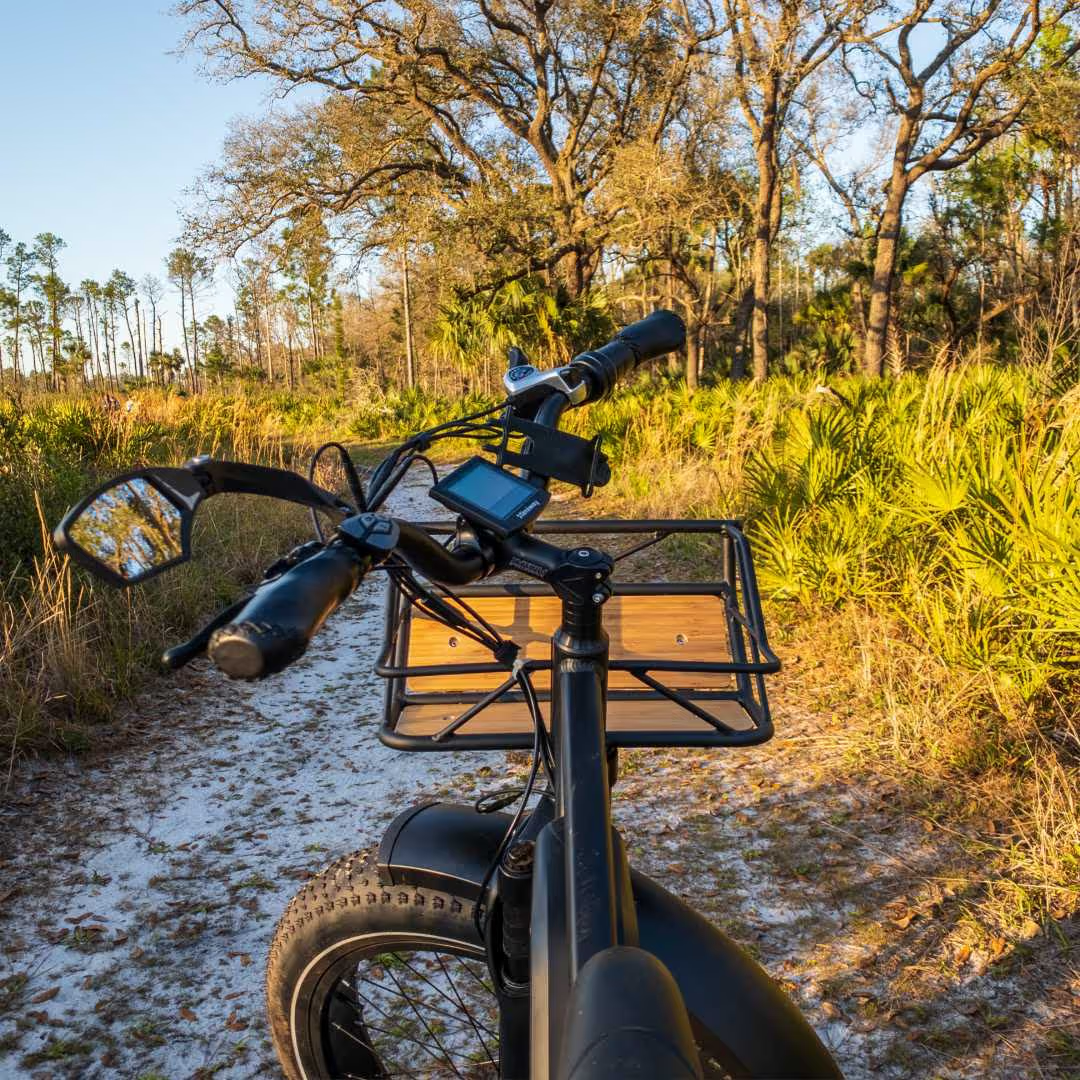
New Zealand draws its e-bike rules around one number: 300 watts. If your electric bike has a motor rated at 300W or less and is designed so you're the main source of power (meaning you have to pedal), it's legally a bicycle. You don't need a licence, registration, warrant of fitness, or any kind of permit. You just ride it.
This is different from most other countries. The UK and Europe use a 250W limit with a 25 km/h speed cutoff. Australia also uses 250W with a 25 km/h cutoff for pedelecs. New Zealand only restricts motor output - if the motor is 300W or less, you're a cyclist regardless of what speed you can reach with pedal assist.
That simplicity is the good part. The confusing part is what happens above 300W.
An e-bike with a motor over 300W is legally a moped in New Zealand. That changes everything. You need to register it, get a warrant of fitness, display a number plate, have front and rear lights, indicators, mirrors, a horn, and hold at least a car driver licence (Class 1). Annual registration and ACC levies apply.
Some imported e-bikes, particularly from online retailers, come with motors rated at 500W or 750W. These are not legal to ride as bicycles in New Zealand. Sellers don't always make this clear. If you're buying online from an overseas retailer, check the motor rating before you order. \"Off-road only\" modes that push past 300W can also be a problem if you ride on public roads or paths.
If the bike doesn't have pedals at all and can exceed 50 km/h, it's classified as a motorcycle, not a moped. Different licence, different registration category, different insurance requirements.
E-bikes under 300W follow the same rules as regular bicycles. That means:
Roads and cycle lanes. You have the same legal right to ride on the road as any cyclist. Use cycle lanes where they exist.
Shared paths and rail trails. You can ride shared paths, separated cycleways, and rail trails. On shared paths, NZTA recommends using a low power setting and cycling at a speed that doesn't put pedestrians and other users at risk. Passing someone at 30 km/h on a narrow shared path is legal but not a good idea.
Bus lanes. Cyclists, including e-bike riders, can use bus lanes. Not bus-only lanes, which are a different thing. If the sign says \"bus lane,\" you can use it. If it says \"bus only,\" you can't.
Footpaths are off limits. You cannot ride a bicycle or e-bike on the footpath in New Zealand unless the wheels are smaller than 355mm in diameter (children's bikes, basically) or you're delivering mail.
Helmets are mandatory for all cyclists in New Zealand, including e-bike riders. Your helmet must meet NZ Standard 2063, or an equivalent overseas standard like AS/NZS 2063 (the joint Australian/New Zealand standard) or certain US and European standards.
This applies on roads, cycle paths, shared paths, and anywhere else you're legally allowed to ride. There is no exception for low speeds or short trips.
Fines for riding without a helmet are relatively small but they do get enforced, particularly in cities.
There is no minimum age for riding an e-bike in New Zealand, the same as for regular bicycles. A child can ride an e-bike as long as the bike is 300W or under and they're wearing a helmet.
If the bike is over 300W (legally a moped), the rider needs a Class 1 driver licence, which means they must be at least 16.
For an e-bike with a motor of 300W or less:
No licence needed. No registration. No WoF. No number plate. Helmet required. Follow the same road rules as any bicycle. Ride on roads, cycle lanes, shared paths, and rail trails. Stay off the footpath.
For an electric bike with a motor over 300W:
Legally a moped. Needs registration, WoF, number plate, indicators, mirrors, lights, horn, and a Class 1 driver licence. Cannot use cycle-only infrastructure.
Some e-bikes have a throttle that lets you ride without pedalling. New Zealand's rules require that a power-assisted cycle is \"designed to be primarily propelled by the muscular energy of the rider.\" A bike with a throttle that provides a brief push to get started (sometimes called a walk-assist mode, typically limited to 6 km/h) is generally fine. A bike that can cruise under throttle power alone without pedalling sits in a grey area and could be classified as a moped depending on the motor output and how it's used.
If your e-bike has a throttle and the motor is under 300W, you're probably fine as long as pedalling is still the primary means of propulsion. If the bike is clearly designed to run on throttle alone, the moped classification may apply regardless of wattage.
When you're shopping, check the motor wattage before anything else. Reputable NZ bike shops sell bikes that comply with the 300W limit. Online purchases from overseas are where people run into trouble. A bike advertised as \"500W\" or \"750W\" is not legal as a bicycle here, even if it was legal where it shipped from.
Look for the motor spec on the product page or in the bike's documentation. If it's not clearly listed, ask the seller before buying.
If you're buying second-hand, the same rules apply. The previous owner may not have known or cared about the wattage limit. Check the motor spec stamped on the motor housing or in the bike's settings if it has a display.
E-bikes under 300W can be insured as bicycles. Standard bicycle insurance covers theft, accidental damage, and in some cases personal liability. Given that e-bikes cost more than regular bikes and get stolen at higher rates, insurance makes sense from a practical standpoint.
E-bikes over 300W fall into the moped category and need motor vehicle insurance, which is a different product with different pricing.
Your home contents policy might cover an e-bike as a personal possession, but the portable item limits on most NZ contents policies ($1,000 to $2,500 typically) often sit below what an e-bike costs. And the excess on a contents claim can be $300 to $500. For an e-bike worth $2,000 or more, standalone bicycle insurance usually provides better coverage.